Is AI Killing Creativity — or Just Changing What It Means to Be Creative?
Estimated reading time: 6 minutes
- AI as a creative partner: Machines are now seen as co-creators, enhancing human creativity.
- Human imagination vs. machine creativity: AI lacks intuition and emotional engagement, fundamental to human creativity.
- Artistic value of AI-generated works: These are increasingly recognized and valued in the art community.
- Creativity democratized: AI tools empower individuals with varied expertise to express themselves creatively.
- Ethical considerations: The rise of AI brings economic and ethical debates about the future of creative jobs.
Table of Contents:
- Generative AI as a Creative Partner
- Human Imagination vs. Machine “Creativity”
- Artistic Value and Reception
- Creativity Redefined and Democratized
- Ethical and Economic Impacts
- Limitations of AI Creativity
- Summary Table: Human vs. AI Creativity
- Conclusion
- FAQ
Generative AI as a Creative Partner
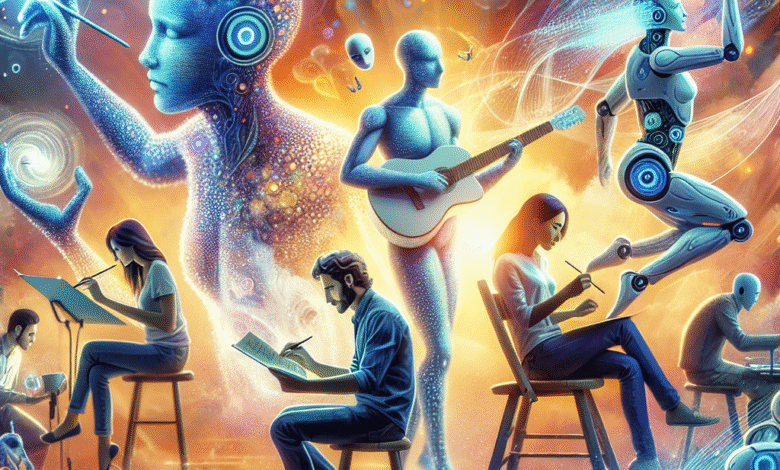
One of the most exciting developments in AI is its role as a creative partner, often referred to as a “co-creator” or “co-pilot.” This collaborative functionality allows writers, artists, musicians, and filmmakers to harness AI throughout their creative workflows, enhancing their artistic capabilities. For instance, artists can utilize AI to generate novel visual forms, musicians to experiment with new styles, and authors to explore diverse narrative avenues. According to sources like the GSD Council and Futuramo, AI facilitates creative experimentation at unparalleled scales and speeds.
This partnership enables creators to push boundaries that may have previously felt insurmountable. With AI’s ability to analyze vast datasets and suggest unique combinations or insights, humans can focus more on the ideation and expression aspects of their work. As creativity becomes increasingly democratized, these tools allow broader participation across creative industries, making it easier for people with little to no technical expertise to engage in artistic activities.
Human Imagination vs. Machine “Creativity”
Despite these advancements, the essence of human imagination remains a one-of-a-kind phenomenon. While AI systems excel at data-driven pattern recognition, they lack the innate attributes of intuition, conscious intent, and emotional engagement. As outlined in articles from Futuramo and Oxford AI Ethics, imagination—the power to conceive entirely new ideas—continues to be a uniquely human trait.
Machines can generate art, music, and text, but their outputs are derived from algorithms and prior training data rather than genuine imaginative thought. The lack of intentionality in AI creations is a key distinction; current AI lacks the ability to reflect on or evaluate the meaning of its outputs. This gap stirs thought-provoking discussions around authenticity and emotional resonance in art and media.
Artistic Value and Reception
Behind the philosophical debates lies a practical reality: AI-generated works are increasingly being perceived as valuable. In some cases, these works are indistinguishable from, or even superior to, those created by humans. For example, Refik Anadol’s “Machine Hallucinations,” an AI-driven sculpture displayed at MoMA, exemplifies this phenomenon. Furthermore, AI-generated images have won major photography awards, highlighting a shift in reception and recognition within the artistic community. Notably, some authors are beginning to credit AI as a co-author, showcasing a fusion of human ingenuity and AI-driven solutions.
Creativity Redefined and Democratized
AI’s influence extends beyond the realms of professional creators to redefine creativity itself, opening doors to new forms of artistic expression. With AI tools, less experienced individuals can bridge technical gaps and explore new styles and media. The fusion of creativity and technology leads to more interdisciplinary approaches, evident in fields like architecture, where practitioners design in collaboration with AI systems, or marketing, where innovative campaigns are developed using AI-generated insights.
As Futuramo points out, AI not only redefines artistic expression but also democratizes participation in the creative process, making it more inclusive for all.
Ethical and Economic Impacts
While there are intriguing advancements, the rise of AI in creative industries raises pressing ethical and economic concerns. The primary risk may not be creativity itself, but rather the economic implications of AI dominating creative job markets. As outlined by the Oxford AI Ethics team, this could result in traditional forms of human creativity being undervalued or marginalized.
However, experts argue that creativity is not a zero-sum game. Artistic innovation has always built upon the foundations laid by previous creators, and AI represents a new source of inspiration rather than a threat. Just as photography did not kill painting, AI is positioned to foster new creative avenues for exploration rather than replace existing methods.
Limitations of AI Creativity
It is essential to acknowledge the limitations present in current AI technologies. Current AI models, despite their impressive capabilities, lack intentionality—the ability to self-evaluate or genuinely imagine. Critics have raised concerns that excessive reliance on machines could lead to formulaic and derivative creations, which may strip artistic expression of its unpredictable and emotional nuances.
The appreciation of AI-created works continues to evolve, provoking thoughtful debates around what constitutes “authentic” creativity. As we explore these limits and the ethical implications of AI, it is crucial to maintain an open dialogue around the value of human creativity in this new landscape.
Summary Table: Human vs. AI Creativity
| Aspect | Human Creators | AI Systems |
|---|---|---|
| Imagination | Originates ideas; intuitive; can “dream” | Data-driven recombination; lacks intuition |
| Intentionality | Creates with intent, meaning, and self-critique | No inherent intent or evaluative judgment |
| Emotional depth | Expresses and evokes genuine emotion | Mimics emotion through learned patterns |
| Process | Slow; iterative; sometimes inefficient | Fast; scalable; data-based |
| Collaboration | Inspires and builds upon others | Collaborates with humans as a tool |
| Limitations | Subjective constraints and bias | Limited to training data and algorithms |
Conclusion
In conclusion, the dialogue surrounding whether AI is killing creativity or altering its definition invites deeper reflection on the nature of artistic expression. While machines now hold the power to paint, write, and compose, they are not capable of truly imagining in the human experience. Rather than seeing AI as a detriment to creativity, we can recognize it as a transformative force that encourages new collaborations and expands artistic possibilities.
As we navigate this evolving landscape together, it’s crucial for HR professionals and business leaders to embrace these technologies not as replacements but as partners in fostering human creativity. Embracing AI tools can enhance workflows, optimize recruitment processes, and ultimately lead to more innovative outcomes in various business sectors.
Are you ready to explore how AI consulting and automation, such as through powerful tools like n8n, can elevate your creative processes and optimize your workflows? Contact us today to discuss how we can help your organization leverage AI to drive unprecedented creativity and efficiency!
FAQ
Q: Is AI capable of true creativity?
A: While AI can generate art, music, and text, it lacks the innate human traits of imagination, intuition, and emotional engagement.
Q: Can AI replace human artists?
A: AI is better viewed as a co-creator that enhances human creativity rather than a replacement.
Q: What are the ethical implications of AI in creative fields?
A: There are concerns about AI affecting job markets and altering how we define artistic value and creativity.