
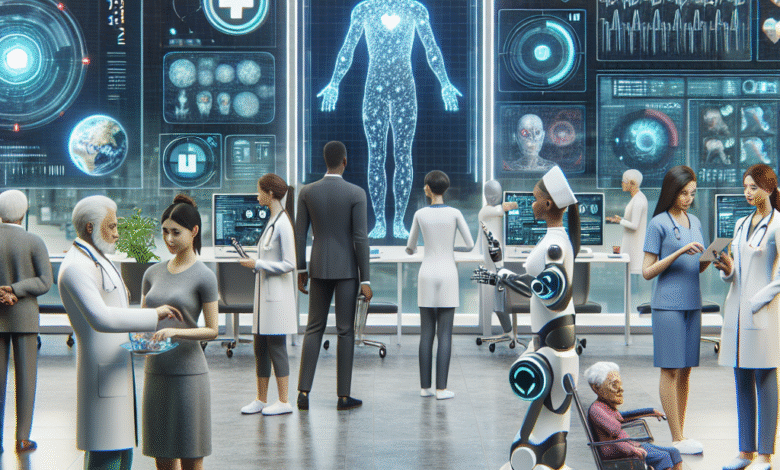
The Future of AI in Healthcare: Transforming Patient Care and Operational Efficiency
Estimated Reading Time: 7 minutes
- AI is pivotal in enhancing patient care and operational efficiency.
- Key applications include predictive analytics, diagnostic assistance, and personalized medicine.
- Integrating workflow automation can significantly improve administrative tasks.
- Challenges include data privacy, interoperability, and workforce adaptation.
- HR professionals must prepare staff for the transitional landscape shaped by AI.
Table of Contents
- Understanding AI and Its Impact on Healthcare
- Trending Applications of AI in Healthcare
- Challenges to Implementing AI in Healthcare
- Actionable Insights for HR Professionals and Recruiters
- How Our AI Consulting Services Can Help
- Conclusion
- FAQ
Understanding AI and Its Impact on Healthcare
Artificial intelligence refers to systems or machines that simulate human intelligence to perform tasks and can iteratively improve themselves based on the information they collect. AI’s capabilities in healthcare extend from data analytics and predictive modeling to automating routine administrative tasks.
Trending Applications of AI in Healthcare
1. Predictive Analytics for Patient Care
Predictive analytics tools can analyze historical and real-time patient data to forecast outcomes and suggest proactive interventions. For instance, identifying patients at risk of hospitalization can allow for timely interventions, improving health outcomes and reducing emergency room congestion. AI can effectively handle large data sets, unearthing insights that would be impossible for humans to process within practical timeframes.
2. Diagnostic Assistance
AI algorithms are increasingly used in imaging, pathology, and genomics to assist radiologists and pathologists by highlighting potential areas of concern that might require further examination. These AI systems enhance diagnostic accuracy and can lead to faster diagnosis times, allowing healthcare professionals to focus their expertise where it is most needed. Nature
3. Workflow Automation with n8n
Integrating workflow automation platforms like n8n can streamline repetitive administrative tasks, such as appointment scheduling, patient follow-ups, and data entry. By automating these tasks, healthcare providers can free up staff to focus more on patient care rather than paperwork. Moreover, n8n’s capabilities enable seamless integration with existing healthcare systems, providing a customizable solution for diverse operational needs.
4. Personalized Medicine
AI plays a significant role in developing personalized treatment plans based on an individual’s genetic makeup, lifestyle, and preferences. This approach increases the effectiveness of treatments and improves patient satisfaction, thus marking a significant departure from the traditional ‘one-size-fits-all’ model of healthcare. Harvard Business Review
5. Improved Patient Engagement
AI-driven chatbots and virtual health assistants can enhance patient engagement by providing real-time responses to inquiries, thereby improving access to information and care. These systems can guide patients through their healthcare journeys, ensuring they follow protocols and adhere to appointments, which is crucial for managing chronic conditions. Gartner
Challenges to Implementing AI in Healthcare
While the potential for AI in healthcare is immense, there are also significant challenges. Privacy and security issues are paramount, given the sensitivity of health data. Additionally, ensuring interoperability among multiple systems can be problematic, complicating the efficacy of AI solutions. Organizations must also navigate regulatory landscapes that can vary widely by region.
Moreover, there can be resistance from healthcare professionals due to job displacement fears, leading to the need for thorough education and training to help the workforce embrace these new technologies equipped for change.
Actionable Insights for HR Professionals and Recruiters
As AI continues to shape the healthcare landscape, HR professionals and recruiters play a vital role in preparing the workforce. Here are some actionable insights:
- Upskill Existing Staff: Encourage ongoing education focusing on AI tools and applications in healthcare. This will enable staff to transition smoothly and take advantage of technological advancements.
- Adapt Recruiting Strategies: Focus on hiring candidates with a strong background in data analysis and technology. This will be crucial as organizations adopt more digital tools.
- Promote a Culture of Innovation: Foster an environment that encourages the exploration of new technologies. This culture will not only enhance employee engagement but also position the organization as a forward-thinking leader in healthcare delivery.
- Strengthen Diversity and Inclusion: Ensure a diverse workforce that encourages a broad range of perspectives. Diverse teams are more innovative and better equipped to serve a diverse patient population effectively.
How Our AI Consulting Services Can Help
At [Your Company Name], we specialize in AI consulting and workflow automation, using platforms like n8n to tailor solutions that drive efficiency and improve care in the healthcare sector. Our team of experts is dedicated to helping organizations navigate the complexities of AI implementation.
- Consultation Services: Assessing your current systems and identifying where AI and workflow automation can make the most significant impact.
- Integration Solutions: Seamlessly integrating AI tools and n8n workflows into your existing processes to optimize operations.
- Training and Support: Providing resources and training sessions for your staff to adapt to new technologies efficiently.
Conclusion
The future of AI in healthcare is undoubtedly transformative, offering a path to enhanced patient care and operational efficiency. By embracing AI technologies, healthcare organizations can address current challenges while preparing for future demands. For HR professionals and recruiters, this suggests an urgent need to adapt strategies and cultivate skills for a workforce ready to thrive in the digital age.
Are you ready to harness the power of emerging AI technologies in your healthcare operations? Contact us today to learn more about our AI consulting services and how we can help you navigate this exciting terrain.
By remaining at the forefront of AI advancements, [Your Company Name] is committed to driving positive change in healthcare through innovation, technology, and automation. Explore our services to learn how we can assist you in optimizing your healthcare delivery for the future.
FAQ
What are the main benefits of AI in healthcare?
AI can enhance diagnostics, improve patient engagement, automate administrative tasks, and enable personalized medicine.
What challenges do healthcare organizations face with AI implementation?
Challenges include privacy concerns, data interoperability, regulatory compliance, and workforce adaptation.
How can HR professionals prepare for AI in healthcare?
HR professionals should focus on upskilling employees, adapting recruiting strategies, and promoting a culture of innovation.


